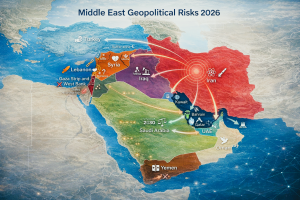
In a significant escalation of hostilities, Israel and Hezbollah exchanged heavy fire on Sunday, marking one of the most intense confrontations between the two since their full-scale war in 2006. Israel’s military confirmed it carried out pre-emptive strikes across southern Lebanon, targeting what it described as thousands of Hezbollah’s rocket launchers, in an attempt to thwart a large-scale rocket and drone attack by the Iran-backed group.
The Israel Defense Forces (IDF) stated that approximately 100 fighter jets were deployed to strike more than 40 sites in southern Lebanon, including strategic positions in Beaufort Castle and the outskirts of several towns. The strikes were launched after detecting extensive preparations for an aerial attack by Hezbollah.
In retaliation, Hezbollah claimed to have fired over 320 rockets and drones at various military facilities in Israel and the occupied Golan Heights. The group, along with its Amal allies, reported that three of their fighters were killed during the exchange. Israel’s military also confirmed the death of an Israeli Navy soldier, allegedly during a Hezbollah drone attack near the Lebanese border.
Israeli Prime Minister Benjamin Netanyahu, speaking from an IDF base in Tel Aviv, warned Hezbollah and Iran’s leadership that Israel’s actions represented a significant shift in the ongoing conflict.
“This is an additional step in changing the situation in the north,” Netanyahu
Hezbollah’s leader, Hassan Nasrallah, later addressed the situation in a televised speech, asserting that the group’s operation had been “completed and accomplished,” dismissing Israeli claims of thwarting a larger attack as “empty.” Nasrallah also warned of further retaliation if Hezbollah deems the response insufficient.
The ongoing violence, which began shortly after the Israel-Hamas conflict erupted in Gaza on October 7, has led to the deaths of over 560 people in Lebanon, predominantly Hezbollah fighters, and 49 casualties in Israel, including civilians and soldiers. The United Nations reported that almost 200,000 people have been displaced on both sides of the border due to the escalating conflict.
As tensions rise, the United States has expressed concern, with White House National Security Adviser Jake Sullivan urging both parties to avoid further escalation. Diplomatic efforts to broker a ceasefire between Israel and Hamas in Gaza, which Hezbollah has linked to its actions, have yet to yield a breakthrough.
Lebanese Prime Minister Najib Mikati, whose government has limited control over Hezbollah, called for an immediate cessation of Israeli strikes and reiterated Lebanon’s support for international efforts to secure peace in Gaza.
As the situation remains volatile, global leaders are closely monitoring the developments, hoping to prevent a broader regional conflict.